
- 10/12/2026
- 338 Views
- Comment
Entering your first ballroom competition is exciting, but it’s also a lot to manage at once—warm-ups, schedules, scoring rules, nerves, and the practical details of making sure you’re competition-ready. The good news: with a simple pre-event game plan, you can arrive focused and confident.
1) Mental prep: how to steady nerves and stay focused
Competition nerves are normal, and they don’t automatically mean you’ll perform poorly. Aim for “readiness,” not “perfect calm.” Before the event, try a short routine you can repeat anywhere: controlled breathing (in for 4, out for 6), a quick body scan to release tension, and one clear performance cue (for example: “posture first,” “follow the frame,” or “start strong”).
On the day, treat the event like a sequence of controllable tasks—warm up, get ready, dance the round you’re in—rather than the whole weekend in one thought. If your mind starts spiraling, bring it back to immediate priorities: timing, connection, and your partner’s cues.
2) What to pack: a practical checklist
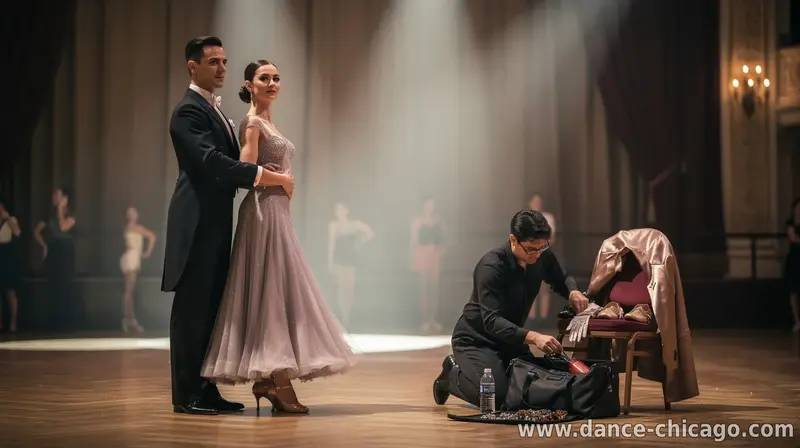
Bring more than you think you need—competitions tend to run on tight timelines, and small problems can become big delays. Pack items that cover footwear, wardrobe readiness, and last-minute repairs.
- Dance shoes and backups: your main competition shoes, plus at least one backup option if possible.
- Costume/partner outfit: full competition wear, with any required undergarments.
- Grooming and hair: hair supplies, pins/clips, and anything you use to keep your look consistent.
- Repair kit: double-sided tape or fashion tape, safety pins, lint remover/roller, needle and thread, and a small pair of scissors.
- Dance day basics: water, snacks that won’t upset your stomach, deodorant, wipes, and hand sanitizer.
If your event allows it, also consider a lightweight garment bag or cover so your outfit stays clean between warm-ups and rounds.
3) What to expect on the day: schedule, warm-up, and flow
Most first-time competitors are surprised by how quickly things move once you arrive. After check-in, you’ll typically find (or be directed to) where to wait, where to warm up, and when your heats/rounds begin. It’s common to feel like you’re waiting for a long time and then suddenly everything is happening at once—especially when you’re close to your next call.
Warm-up usually happens in designated areas and may be more structured than casual practice. Plan to arrive with time to settle in, confirm your next steps, and run a short mental warm-up with your partner: review the key start timing, posture focus, and any commonly used cues. When you’re called, move efficiently but don’t rush your routine—your first impression is built from calm preparation.
4) Competition execution tips: do less, dance better
In your first competition, your goal isn’t to “prove” anything—it’s to compete with control. Many newcomers overthink footwork and details mid-round. Instead, commit to a small set of priorities you can feel: grounded feet, consistent frame, and clear leads/follows. If something goes wrong, keep moving—ballroom is about continuity and recovery.
After your round, don’t let the outcome hijack your next attempt. Take a brief reset with your partner: check what you can carry forward (timing, connection, intensity) and quickly move on. That mindset is often the difference between a stressful first outing and a productive one.
Finally, remember that everyone around you is there for the same reason: to learn, perform, and improve. If you need help—directions to warm-up areas, how to check a schedule, or where to find organizers—ask. Most competitions are built to welcome newcomers, and the fastest way to feel confident is to get oriented early.
Related materials
Be the first to share your opinion with others.