
- 10/12/2026
- 245 Views
- Comment
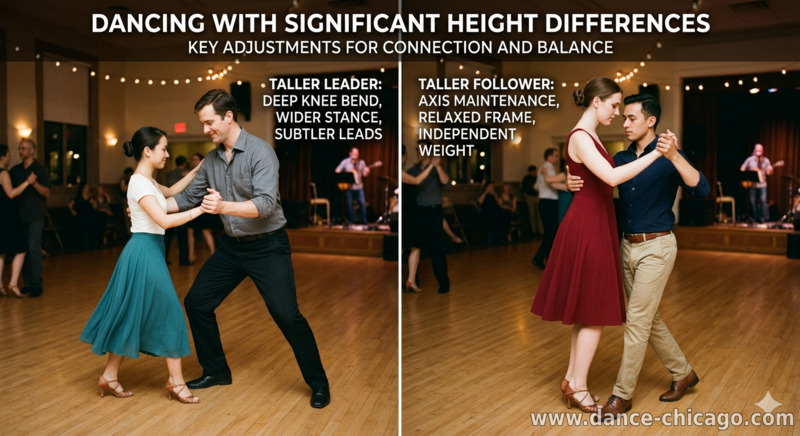
Dancing with someone who’s taller or shorter than you can be a surprisingly common challenge—especially in partnered styles like social dance, ballroom, salsa, or swing. Height differences can change how close you stand, where your hands land, and how smoothly you rotate together.
The good news: with a handful of adjustments to your posture, spacing, and timing, you can make the partnership feel natural and look polished.
1) Start with a stable, comfortable frame
Before you move, prioritize a frame you can hold consistently. If you’re taller, avoid reaching downward with your shoulders—keep your torso tall and let your elbows bend naturally. If you’re shorter, resist hunching up; instead, raise your posture from the core and adjust your arm angle so your hands meet without straining.
Think “connected and relaxed,” not “stretched.” A stable frame reduces wobble, which is especially noticeable during turns.
2) Adjust your spacing and distance
Height changes the geometry of the dance. If you’re too far apart, the shorter partner may lose leverage; if you’re too close, the taller partner may feel cramped during rotations. Find the sweet spot by testing a basic step slowly first.
As a general rule, aim for connection at the point where your partner can maintain posture without lifting shoulders. Even a small shift—half a step in or out—can noticeably improve alignment.
3) Align hands, not just positions
In many partner dances, the “line” your arms create matters as much as foot placement. Taller partners often need to soften their elbow height; shorter partners may need to slightly angle forearms to match the shared hand position.
Keep wrists neutral and avoid forcing your arms into the same height level. Instead, use angles that feel natural for both of you—connection should be comfortable, with room for motion.
4) Modify turns and timing to match body range
Turns reveal height differences quickly. Taller partners may cover more distance per rotation; shorter partners may need smaller, quicker steps to maintain rhythm. Rather than trying to mirror each other’s stride length exactly, synchronize through timing.
For tighter turns, focus on clean pivots and controlled foot placement rather than bigger traveling steps. For bigger rotations, agree on pacing early: slow the transition into the turn, then commit to the rotation together.
If you’re leading, cue the partner’s “set” with your body timing—don’t rely only on arm tension. If you’re following, watch the leader’s torso and hips for the true initiation, not just the hand guidance.
Height can also affect balance points during changes of direction. Keep your weight transfers precise and avoid rushing the step before the turn—rushing is what usually creates loss of alignment.
5) Use the right wardrobe and footing habits
Footwear matters more than people expect, particularly for height-mismatch pairings. If you’re the shorter partner, shoes with too little support can make you feel unstable during turns. If you’re the taller partner, overly stiff footwear can limit quick pivots.
During practice, use small markers on the floor or practice near a wall (if your space allows) to confirm your range of motion before dancing at full speed.
Finally, remember that friction and traction matter: similar shoes help both partners read the floor the same way, which improves synchronization.
With the right adjustments—comfortable frame, better spacing, aligned connection points, and turn timing—you can dance smoothly with a height difference instead of fighting it. Treat it like tuning an instrument: start slow, find what feels aligned for both bodies, and build from there.
If you can, practice a few basics together (a gentle step, a simple turn, and a basic “pause and reconnect”). Those fundamentals will carry over into more advanced patterns while making the partnership feel effortless.
Related materials
Be the first to share your opinion with others.