
- 09/23/2026
- 19 Views
- Comment
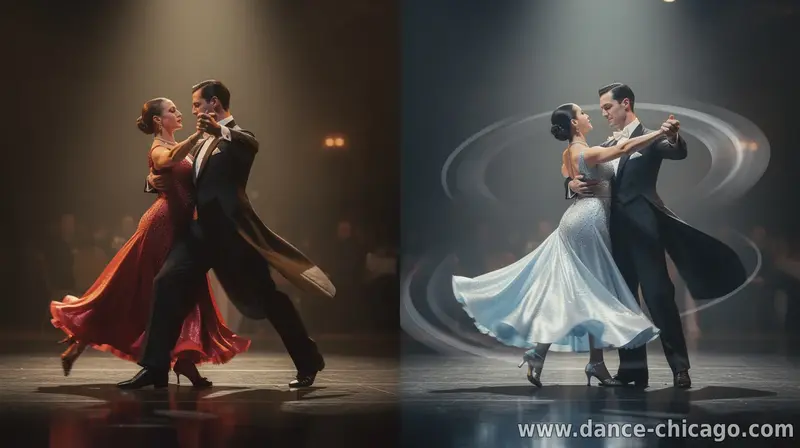
Tango and the Viennese Waltz are often grouped together as classic social-dance traditions, yet they ask dancers to do nearly opposite things with posture, connection, and momentum. While both styles reward musical sensitivity, the way their frames move through space—slowly drawn in tango, and continuously carried in Viennese waltz—creates distinct visual and kinetic identities.
Tango: a compact frame built for tension
In tango, the frame is typically tighter and more intentional, emphasizing a poised upper body and controlled distance between partners. Dancers often keep the torso engaged and the connection stable, so the movement reads as deliberate and weight-led rather than broadly “opened.” Even when steps travel, the overall impression is of balance under tension—compact, grounded, and ready to change direction.
This focus on stability is closely tied to tango’s characteristic energy: a mix of stillness and sudden propulsion. Micro-pauses, sharp accents, and changes in pressure help create a sense of conversation with the music. The embrace encourages clarity—what is supported feels secure, and what is released feels dramatic.
Viennese Waltz: a sweeping frame designed to travel
The Viennese Waltz favors a more expansive, continuously rotating relationship between partners. Frames tend to be lifted and elongated, supporting a smooth rise and fall that aligns with the dance’s faster tempo. Rather than relying on compact tension, dancers cultivate momentum through consistent rotation—turning is the engine, and the frame acts as the stabilizing structure that lets rotation stay effortless.
Energy in the Viennese Waltz is often described as flowing and buoyant, with an emphasis on glide. Footwork and body motion blend into a long musical line, so the dance feels like uninterrupted movement—less about abrupt changes in pressure and more about sustained, rhythmic carry.
Key differences in connection and “pressure”
Although both dances require partnership and responsiveness, their connection styles often feel different on the body. Tango frequently uses pressure changes—subtle intensification or relaxation—to shape phrasing and dramatize accents. The result is a frame that can look still while the dynamics inside it shift quickly.
By contrast, the Viennese Waltz generally prioritizes uniformity and continuity in the frame. The connection supports consistent rotation and smooth traveling, so the energy reads as steady even when the movement challenges balance at speed.
Movement outcomes: drama vs. glide
These frame philosophies lead to different visual signatures. Tango’s grounded compactness often highlights dramatic leg lines, precise timing, and expressive pauses. Viennese waltz typically highlights sweeping travel, even rotation, and the unmistakable rise-and-fall that emerges from sustained speed.
For dancers, that means technique goals differ. Tango training commonly emphasizes balance, weight placement, and connection management to keep movements controlled under dynamic phrasing. Viennese waltz training tends to prioritize smooth alignment, rotational stability, and maintaining a traveling tone at faster tempos.
Ultimately, tango and Viennese waltz both turn partnership into music, but they do it through contrasting frameworks. Tango asks for intentional tension and grounded control; Viennese waltz asks for elevated continuity and effortless glide.
Related materials
Be the first to share your opinion with others.