
- 09/20/2026
- 73 Views
- Comment
For children ages 4–7, dance is a structured way to practice movement many families want for early development—control, balance, rhythm, and spatial awareness. While it may look like play, dance classes and at-home routines can repeatedly challenge the brain and body to coordinate actions.
At the center of dance’s benefits is motor learning: kids practice controlling their bodies through patterns. When a child follows a beat, copies a step, or transitions from one move to the next, they are refining how their muscles work together—improving timing, posture, and movement accuracy.
Coordination grows through step-by-step patterns
Many dance activities require both sides of the body to work in coordinated ways—such as stepping in rhythm, moving arms opposite the legs, or clapping while turning. Repeating these sequences helps children improve bilateral coordination (using both sides together) and develops smoother transitions, which are key building blocks for everyday skills like running, climbing, and playground play.
Balance and body awareness improve with movement challenges
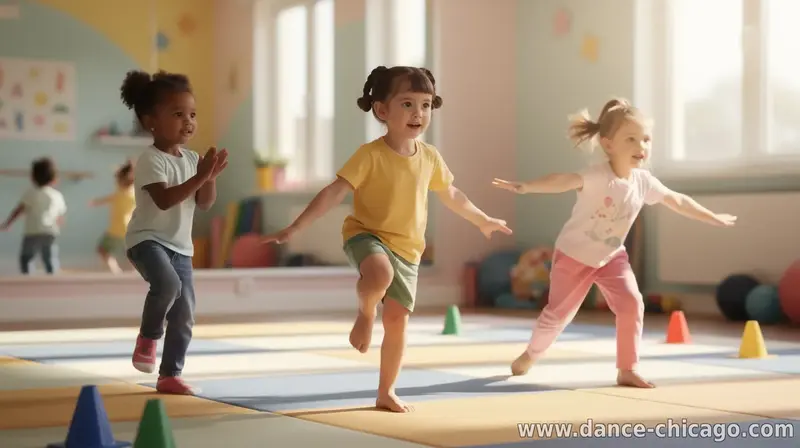
Simple dance tasks—standing on one foot for a pose, stepping over imaginary “lines,” or making controlled turns—ask children to stabilize themselves. These moments train the systems involved in balance and spatial orientation, including how children sense where their body is in space and how to correct small misalignments before they wobble or fall.
Over time, that body awareness can support better posture and movement form. Children who feel more confident controlling their bodies are often more willing to try new physical activities, reinforcing skill development.
Rhythm supports timing and attention
Dance is tightly connected to rhythm, and rhythm is closely linked to timing. When kids move to music, they practice “when to do it,” not just “how to do it.” Following a beat can encourage sustained attention and listening skills—because the next movement depends on hearing and anticipating what comes next.
This kind of timing practice also benefits transitions, such as stopping on a cue, starting on the next count, or changing direction without rushing. Those skills translate well to sports, games, and even classroom movement routines.
Fine- and gross-motor skills develop together
Dance blends large movements (jumping, stepping, stretching) with smaller actions (hand gestures, arm lines, claps, and reaching). That mix can help children strengthen gross-motor control while also practicing fine-motor coordination through precise gestures and coordinated arm movements.
For many 4–7-year-olds, the combination matters: gross-motor improvements build confidence and strength, while guided hand and arm patterns refine control and coordination.
There’s also a developmental advantage to variety. Dance typically cycles through locomotor skills (walk, run, hop), non-locomotor skills (balance, sway, pose), and directional changes (turning, shifting levels). That diversity helps kids practice a wide range of movement demands in one activity.
Parents and caregivers can maximize the benefits by keeping sessions playful and age-appropriate. Look for classes that emphasize clear instructions, encouraging feedback, and movement options for different skill levels. At home, short routines—5 to 15 minutes—can be enough if they include a warm-up, a few repeated steps, and time for free movement to music.
Safety is also part of effective skill-building. Choose a space with room to move, use supportive footwear or dance slippers if appropriate, and avoid pushing children into complex choreography beyond their comfort. If a child has concerns about pain, frequent falls, or coordination difficulties, it can be helpful to discuss them with a pediatric clinician or qualified movement professional.
For ages 4–7, dance can be a practical, enjoyable tool for motor development: it strengthens coordination, balance, timing, and body awareness—skills that support both physical development and confidence. With consistency and a supportive approach, kids can turn music and movement into real progress they’ll use every day.
Related materials
Be the first to share your opinion with others.