
- 09/22/2026
- 142 Views
- Comment
Samba can sound familiar to anyone who loves Latin music, but once you move to it, the difference becomes obvious. Compared with many other popular Latin dances, samba’s “feel” is shaped by a tight relationship between percussion, hip articulation, and an elastic, forward-driving flow that rarely lets the dancer settle into a purely side-to-side groove.
That distinctive sensation starts with rhythm. Samba is typically built around repeating patterns from instruments like surdo, tamborim, and repinique, creating a pulse that’s both propulsive and syncopated. Instead of treating the beat as evenly spaced steps, samba encourages dancers to treat timing as something you ride—absorbing the accents and responding with motion that lands slightly before or after you expect, depending on the musical phrase.
Hip action that feels “spring-loaded,” not just rhythmic
Another reason samba feels different is the way hip movement is integrated into travel. In many partner and social dance styles, hip action can be an accent added on top of footwork. Samba does the reverse: the feet and torso movement help set up the hip’s range, and the hip action becomes a driving mechanism that gives the steps their characteristic bounce.
That’s why samba often looks like it has a constant, gentle spring. Even when the steps appear simple, the body stays active—creating a subtle tension-and-release effect through the knees, ankles, and hips.
Posture and “weight transfer” define the bounce
Samba also has a distinctive posture and weight-transfer pattern. Many dancers describe the movement as grounded and low, but not heavy. The result is an athletic kind of buoyancy: you absorb down into the step while keeping the torso alive, then redirect that energy forward or across the floor without fully “plopping” into the next beat.
This weight transfer is what separates samba’s motion from dances that rely more on upright sway or long, smooth glides. In samba, the dancer frequently moves the center of mass in quick, controlled increments—so the dance feels more like rolling momentum than continuous drifting.
Breath and phrasing: the dance “talks” with the music
Musically, samba choreography often mirrors how the percussion calls and answers itself. Short motifs, rhythmic variations, and crescendos in the drum pattern influence where dancers emphasize or soften their steps. Skilled performers tend to “phrase” their movement—making the body respond to musical punctuation rather than only to the underlying tempo.
That musical conversation is a major part of what people mean when they say samba feels alive. You don’t just keep time; you interpret it.
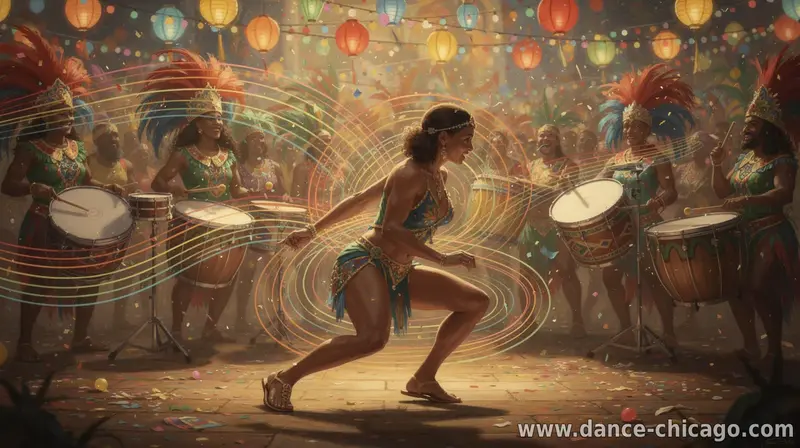
Finally, samba’s cultural context contributes to its energy. Originating from Afro-Brazilian traditions and later becoming closely associated with Brazilian carnival, the dance carries an emphasis on communal rhythm and celebratory intensity. Even in a social setting, that background often shows up as a more exuberant approach—movement that feels expressive, not merely technical.
In short, samba feels different because it’s built on a rhythmic architecture, a specific physical mechanics of hip-and-weight interplay, and musical phrasing that turns the dancer into an interpreter of percussion. Learn the patterns, feel the bounce, and you’ll quickly understand why it doesn’t behave like “just another Latin dance”—it has its own language.
Related materials
Be the first to share your opinion with others.