
- 09/20/2026
- 144 Views
- Comment
Argentine tango and ballroom tango both trace their roots to tango’s broader history, but they have evolved into distinct dance styles with different cultural influences and performance standards. For viewers, the most noticeable differences often appear in posture, footwork, the “feel” of timing, and how couples interact on the floor.
While Argentine tango typically emphasizes improvisation and close musical conversation between partners, ballroom tango is shaped by codified technique and standardized patterns designed for competitive performance. Understanding these contrasts helps explain why two dances that look related can feel fundamentally different.
Origins and how each style developed
Argentine tango emerged in Argentina—especially in Buenos Aires—where it became closely tied to social dance culture and the relationship between dancers and music. Over time, it diversified into variations such as milonguero (often associated with smaller, close-walk styles) and salon (generally more expansive), all while keeping improvisation central.
Ballroom tango, by contrast, became formalized as tango entered international ballroom circuits and competitions. Its rules, line of dance concepts, and technical expectations were refined to create consistency across performances, especially in partner dance formats used on competitive stages.
Posture, connection, and movement goals
In many Argentine tango styles, dancers commonly adopt a lower, more grounded torso placement with a strong emphasis on listening—responding to rhythm changes, accents, and pauses. The dance often features a dynamic mix of walking, sharp directional changes, and “signals” through torso and leg action that guide the partner.
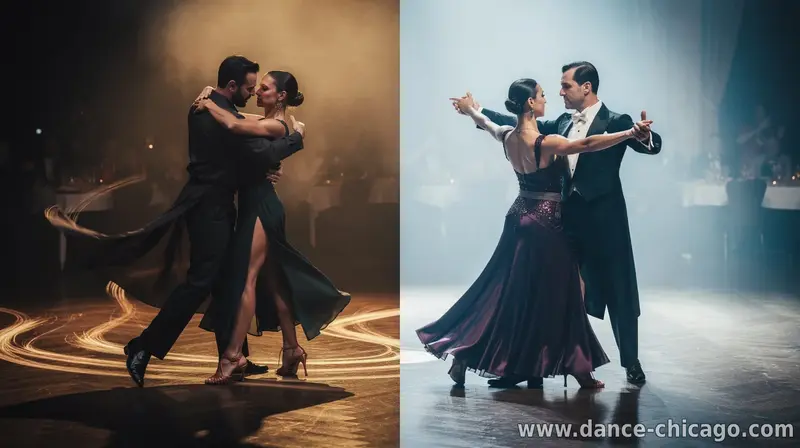
Ballroom tango typically uses a more formalized frame: a defined upright posture and a regulated hold, paired with movements that travel in a controlled line. Instead of improvisation driving the choreography, ballroom tango often follows repeatable figures and pattern structures that emphasize shape, symmetry, and overall presentation.
Footwork, timing, and musical interpretation
Argentine tango is strongly shaped by the music’s phrasing and the dancers’ ability to interpret it in real time. Footwork can be intricate and expressive—often favoring quick weight transfers, grounding steps, and stylized pauses that make the dance feel conversational rather than pre-written.
Ballroom tango is also musical, but the interpretation tends to be expressed through standardized figures and the consistent execution of technique. Timing is often focused on the clarity of pattern steps and the characteristic “tango walk,” with emphasis on controlled momentum and clean lines.
Leading, following, and improvisation
Argentine tango is widely known for its improvisational nature. Even when dancers share similar movement “vocabulary,” the exact sequence can change from moment to moment, guided by partner connection and musical cues. This can make each performance feel unique—especially in social contexts.
Ballroom tango typically places improvisation at a lower priority in competitive settings. Partners are expected to deliver specific figures with dependable spacing and alignment, making the dance more comparable from couple to couple during competitions.
How to recognize them when watching
If you’re trying to tell them apart quickly, focus on a few visible cues: the closeness and grounded quality of Argentine tango, the more upright and formal frame often seen in ballroom tango, and the presence (or absence) of improvised-looking variations. Argentine tango may feel more “elastic,” with frequent pauses and sudden changes in direction, while ballroom tango often appears more geometric and pattern-driven.
In short, Argentine tango and ballroom tango share a family resemblance, but they’re built for different goals. Argentine tango often prioritizes musical dialogue and improvisation, while ballroom tango aims for standardized technique, recognizable figures, and competition-ready presentation.
Related materials
Be the first to share your opinion with others.