
- 09/20/2026
- 263 Views
- Comment
Practicing ballroom dancing at home between lessons doesn’t require a full studio setup—just consistency, clear goals, and exercises that translate directly to what you’re learning. Whether you’re working on waltz, foxtrot, tango, or quickstep, the key is to build the fundamentals you can’t fully drill during a single class: frame, timing, balance, and clean foot placement.
Start by planning your week around two or three short sessions rather than one long practice. A practical target is 20–45 minutes, depending on space and energy. Before you begin, decide what you’re working on that week—such as maintaining frame, improving rise-and-fall, or tightening step timing—and keep that goal in view throughout your session.
Warm up with body alignment and balance
Before you practice steps, spend 5–10 minutes on alignment. Stand tall with relaxed shoulders, steady core engagement, and a neutral head position. For balance, do slow controlled weight transfers (left to right, forward to back) while keeping your posture unchanged. This helps you avoid compensating for poor footing with your upper body.
If you have space, include a few “stillness” drills: pause in your starting stance for several seconds, then restart smoothly. These short pauses train steadiness—an essential ingredient for consistent lead-and-follow look and feel.
Use solo footwork to improve accuracy
Between lessons, solo practice is your fastest path to cleaner timing. Focus on stepping quality: place the foot decisively, control the transfer of weight, and avoid dragging. Practice the basic step pattern for the style you’re studying, repeating it at slow-to-medium tempo until the movement feels automatic.
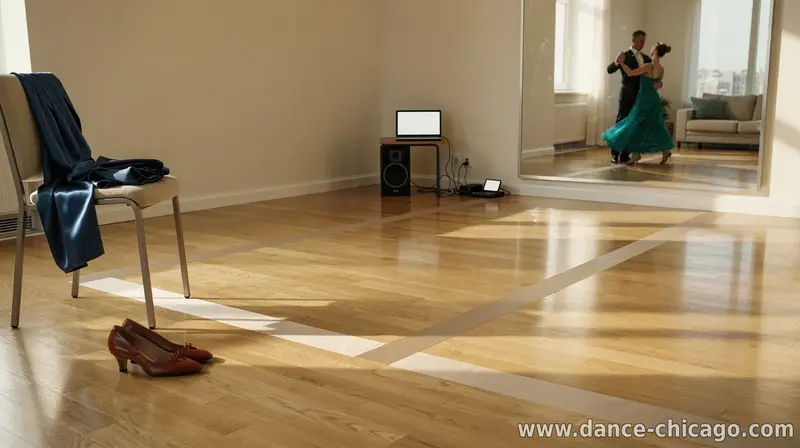
For added precision, mark the floor with tape if possible. A simple line or two reference points can help you keep tracks straight and reduce “drift.” Aim for consistency over speed—if your steps get sloppy when you move faster, slow down and rebuild.
Train rhythm with music (and a metronome if needed)
Ballroom improvement often comes down to timing. Choose tracks you can clearly count along with—then practice on one consistent tempo for several rounds. If you struggle to find the beat, use a metronome or a counting track and align your steps to the counts rather than to how the music “feels.”
A useful approach is: play music, practice 1–2 basic patterns only, stop, then repeat with slight adjustments. This creates quick feedback loops and prevents you from locking in timing errors.
Build “frame” fundamentals even without a partner
Many dancers focus on feet and forget that the upper body is what sells the movement. Even in solo practice, you can rehearse frame: maintain elbow placement, keep the connection steady (imagining a partner’s hand position if needed), and practice turning your torso from a stable core. If your arms tense up, reduce effort and prioritize smoothness.
If you do have a partner, practice short, controlled walking or “step and stop” sequences together—focus on maintaining consistent connection and direction changes rather than full routines.
Simulate real practice with short rounds
To mimic lesson conditions, structure your session like this: do a warm-up, then a “technique round” (one exercise repeated), then a “timing round” (the same movement with music at the target tempo), followed by a “review round” where you run your current lesson material at a slower pace.
End with a brief self-check: Did your posture stay stable? Were steps placed cleanly? Did timing match the beat? Write one sentence about what improved and one about what to change next time—this makes the next practice session more effective.
Finally, keep expectations realistic. Home practice should reinforce what you already learned, not overwhelm you with new choreography. By practicing fundamentals—alignment, footwork accuracy, and rhythm—for short, consistent sessions between lessons, you’ll return to class more prepared and progress faster.
Related materials
Be the first to share your opinion with others.