
- 09/20/2026
- 98 Views
- Comment
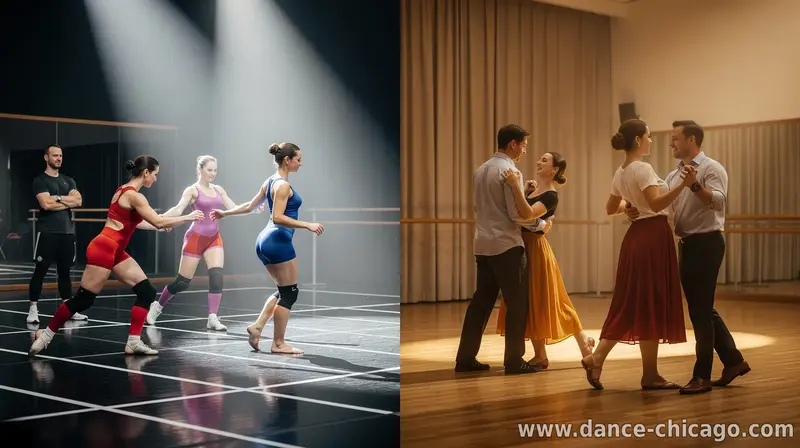
Dance communities often share studios, instructors, and even the same dance styles—yet the way students train can change dramatically depending on whether they’re aiming for competitive events or social floors. While both paths build technique and confidence, competition-focused programs typically optimize for scoring, precision, and performance under pressure.
At the center of the difference is the goal. Social dance lessons generally focus on connection, musicality, and usability in everyday social settings—think partner leading/following in real time, comfortable improvisation, and learning steps that translate to different venues. Competition training, by contrast, is oriented toward measurable performance criteria: consistency, synchronization, projection, and elements evaluated by judges or choreographic rubrics.
What students practice (and why)
In social lessons, practice often emphasizes adaptability. Students may work on how to recover from mistakes, navigate changing partner dynamics, or choose variations that fit the energy of a crowd. Teachers commonly tailor drills to real-world scenarios: dancing at different speeds, maintaining frame while communicating, and building “safe” options for less predictable partner situations.
Competition training tends to revolve around repeatable performance quality. That can include longer technical routines, more deliberate repetition of key sequences, and structured rehearsal blocks designed to reduce timing variance. Dancers may also spend more time on details that are less visible on a social floor—such as line accuracy, transitions between motifs, and choreographic hit points.
Feedback style and performance pressure
Feedback also reflects each track’s priorities. Social instructors often coach for clarity and comfort—helping students feel successful in a wide range of dance contexts. Corrections may be framed around improving flow, maintaining partner communication, or increasing the chance that a move “lands” smoothly.
Competition coaching is frequently more exacting and data-like. Coaches may break down performance into judge-relevant components, request specific changes to reduce deductions, and use targeted drills to refine individual weaknesses. Students can receive frequent notes on posture, timing alignment, or styling consistency, along with rehearsal strategies for performing confidently under competition conditions.
Progression: from learning steps to building a routine
Social learners often progress by expanding their repertoire and comfort level. The emphasis may be on adding versatile combinations, improving responsiveness to partners, and developing personal interpretation. Even when choreography is taught, it’s commonly framed as something that can be adapted rather than performed identically every time.
Competition students usually progress through a more regimented process: learning choreography, rehearsing it repeatedly, and developing performance stamina. As events approach, the training can become more specialized—such as polishing entries and exits, tightening footwork timing, and refining expression so it reads clearly to judges at a distance.
In both settings, students benefit from strong fundamentals, but the path to mastery differs. If you want to dance comfortably with many partners and in varied social situations, social lessons may offer faster real-world returns. If your aim is to compete—or simply to experience the discipline and precision that competition demands—competition training can provide a more structured route to performance-level technique.
Ultimately, many dancers blend both approaches. A social lesson can keep technique grounded in real-floor dynamics, while competition training can elevate consistency and stage presence. The best choice depends on what you want your dance skills to deliver: connection in the moment, or repeatable performance excellence.
Related materials
Be the first to share your opinion with others.